KCNA Test Dumps Pdf, KCNA New Test Bootcamp
Wiki Article
BTW, DOWNLOAD part of ValidTorrent KCNA dumps from Cloud Storage: https://drive.google.com/open?id=1NKHcM9pNffCedWkrAyStgD5Pw_W9raLN
God wants me to be a person who have strength, rather than a good-looking doll. When I chose the IT industry I have proven to God my strength. But God forced me to keep moving. Linux Foundation KCNA exam is a major challenge in my life, so I am desperately trying to learn. But it does not matter, because I purchased ValidTorrent's Linux Foundation KCNA Exam Training materials. With it, I can pass the Linux Foundation KCNA exam easily. Road is under our feet, only you can decide its direction. To choose ValidTorrent's Linux Foundation KCNA exam training materials, and it is equivalent to have a better future.
The Kubernetes and Cloud Native Associate (KCNA) certification exam is offered by the Linux Foundation, a non-profit organization that aims to promote and support open source technology. Kubernetes and Cloud Native Associate certification exam is designed to test the knowledge and skills of individuals who are interested in working with Kubernetes and cloud native technologies. KCNA Exam covers a range of topics, including containerization, Kubernetes architecture, deployment, and management.
KCNA Test Dumps Pdf - 100% Pass Realistic Linux Foundation Kubernetes and Cloud Native Associate New Test Bootcamp
We have to admit that the exam of gaining the KCNA certification is not easy for a lot of people, especial these people who have no enough time. If you also look forward to change your present boring life, maybe trying your best to have the KCNA Certification is a good choice for you. Now it is time for you to take an exam for getting the certification.
Linux Foundation Kubernetes and Cloud Native Associate Sample Questions (Q140-Q145):
NEW QUESTION # 140
What are cluster-wide objects
- A. Service and Pods
- B. Volumes and Nodes
- C. ConfigMaps and Secrets
Answer: B
Explanation:
https://kubernetes.io/docs/concepts/overview/working-with-objects/_print/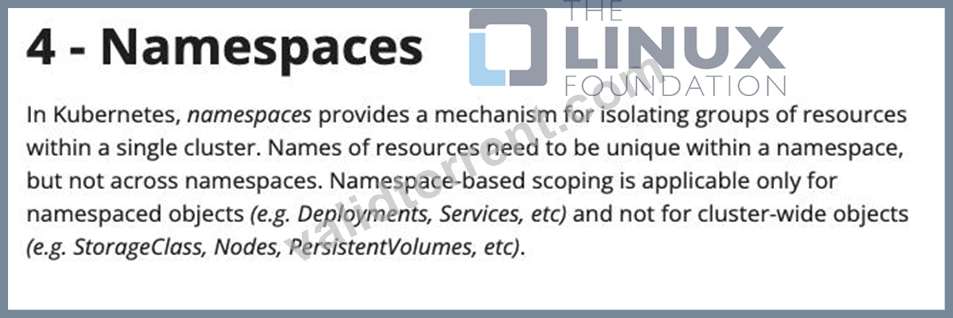
NEW QUESTION # 141
What is a probe within Kubernetes?
- A. A monitoring mechanism of the Kubernetes API.
- B. A logging mechanism of the Kubernetes API.
- C. A diagnostic performed periodically by the kubelet on a container.
- D. A pre-operational scope issued by the kubectl agent.
Answer: C
Explanation:
In Kubernetes, a probe is a health check mechanism that the kubelet executes against containers, so C is correct. Probes are part of how Kubernetes implements self-healing and safe traffic management. The kubelet runs probes periodically according to the configuration in the Pod spec and uses the results to decide whether a container is healthy, ready to receive traffic, or still starting up.
Kubernetes supports three primary probe types:
Liveness probe: determines whether the container should be restarted. If liveness fails repeatedly, kubelet restarts the container (subject to restartPolicy).
Readiness probe: determines whether the Pod should receive traffic via Services. If readiness fails, the Pod is removed from Service endpoints, preventing traffic from being routed to it until it becomes ready again.
Startup probe: used for slow-starting containers. It disables liveness/readiness failures until startup succeeds, preventing premature restarts during initialization.
Probe mechanisms can be HTTP GET, TCP socket checks, or exec commands run inside the container. These checks are performed by kubelet on the node where the Pod is running, not by the API server.
Options A and D incorrectly attribute probes to the Kubernetes API. While probe configuration is stored in the API as part of Pod specs, execution is node-local. Option B is not a Kubernetes concept.
So the correct definition is: a probe is a periodic diagnostic run by kubelet to assess container health/readiness, enabling reliable rollouts, traffic gating, and automatic recovery.
NEW QUESTION # 142
What are the 3 pillars of Observability?
- A. Resources, Logs, and Tracing
- B. Metrics, Logs, and Traces
- C. Metrics, Data, and Traces
- D. Metrics, Logs, and Spans
Answer: B
Explanation:
The correct answer is A: Metrics, Logs, and Traces. These are widely recognized as the "three pillars" because together they provide complementary views into system behavior:
Metrics are numeric time series collected over time (CPU usage, request rate, error rate, latency percentiles). They are best for dashboards, alerting, and capacity planning because they are structured and aggregatable. In Kubernetes, metrics underpin autoscaling and operational visibility (node/pod resource usage, cluster health signals).
Logs are discrete event records (often text) emitted by applications and infrastructure components. Logs provide detailed context for debugging: error messages, stack traces, warnings, and business events. In Kubernetes, logs are commonly collected from container stdout/stderr and aggregated centrally for search and correlation.
Traces capture the end-to-end journey of a request through a distributed system, breaking it into spans. Tracing is crucial in microservices because a single user request may cross many services; traces show where latency accumulates and which dependency fails. Tracing also enables root cause analysis when metrics indicate degradation but don't pinpoint the culprit.
Why the other options are wrong: a span is a component within tracing, not a top-level pillar; "data" is too generic; and "resources" are not an observability signal category. The pillars are defined by signal type and how they're used operationally.
In cloud-native practice, these pillars are often unified via correlation IDs and shared context: metrics alerts link to logs and traces for the same timeframe/request. Tooling like Prometheus (metrics), log aggregators (e.g., Loki/Elastic), and tracing systems (Jaeger/Tempo/OpenTelemetry) work together to provide a complete observability story.
Therefore, the verified correct answer is A.
NEW QUESTION # 143
Which of these is a valid container restart policy?
- A. On update
- B. On failure
- C. On login
- D. On start
Answer: B
Explanation:
The correct answer is D: On failure. In Kubernetes, restart behavior is controlled by the Pod-level field spec.restartPolicy, with valid values Always, OnFailure, and Never. The option presented here ("On failure") maps to Kubernetes' OnFailure policy. This setting determines what the kubelet should do when containers exit:
Always: restart containers whenever they exit (typical for long-running services) OnFailure: restart containers only if they exit with a non-zero status (common for batch workloads) Never: do not restart containers (fail and leave it terminated) So "On failure" is a valid restart policy concept and the only one in the list that matches Kubernetes semantics.
The other options are not Kubernetes restart policies. "On login," "On update," and "On start" are not recognized values and don't align with how Kubernetes models container lifecycle. Kubernetes is declarative and event-driven: it reacts to container exit codes and controller intent, not user "logins." Operationally, choosing the right restart policy is important. For example, Jobs typically use restartPolicy: OnFailure or Never because the goal is completion, not continuous uptime. Deployments usually imply "Always" because the workload should keep serving traffic, and a crashed container should be restarted. Also note that controllers interact with restarts: a Deployment may recreate Pods if they fail readiness, while a Job counts completions and failures based on Pod termination behavior.
Therefore, among the options, the only valid (Kubernetes-aligned) restart policy is D.
NEW QUESTION # 144
You are developing a serverless application using Azure Functions that processes real-time streaming dat
a. How would you ensure reliable and efficient data ingestion from a Kafka topic to your Azure Functions?
- A. Configure Azure Functions to poll Kafka topics directly-
- B. Use Azure Service Bus to act as a message broker between Kafka and Azure Functions.
- C. Use Azure Event Hubs to connect Kafka to Azure Functions-
- D. Use a custom connector to integrate Kafka with Azure Functions.
- E. Utilize Azure Data Factory to create pipelines for data movement between Kafka and Azure Functions.
Answer: C
Explanation:
Azure Event Hubs is the recommended approach for connecting Kafka to Azure Functions for real-time streaming data ingestion. It offers high throughput and scalability, making it ideal for handling large volumes of streaming events. Service Bus (B) is suitable for message queuing but not primarily designed for streaming data. Directly polling Kafka topics (C) can be inefficient and might not scale well. Custom connectors (D) can be complex and might lack the required functionality for streaming data ingestion. Data Factory (E) is more focused on data movement and transformation, not real-time streaming
NEW QUESTION # 145
......
As job seekers looking for the turning point of their lives, it is widely known that the workers of recruitment is like choosing apples---viewing resumes is liking picking up apples, employers can decide whether candidates are qualified by the KCNA appearances, or in other words, candidates’ educational background and relating KCNA professional skills. Knowledge about a person and is indispensable in recruitment. That is to say, for those who are without good educational background, only by paying efforts to get an acknowledged KCNA Certification, can they become popular employees. So for you, the KCNA latest copyright complied by our company can offer you the best help.
KCNA New Test Bootcamp: https://www.validtorrent.com/KCNA-valid-exam-torrent.html
- Reliable KCNA Test Experience ???? KCNA Reliable Test Voucher ???? KCNA Latest Test Format ???? Open website ➡ www.validtorrent.com ️⬅️ and search for “ KCNA ” for free download ????Valid KCNA Exam Materials
- KCNA Latest Exam Dumps ???? Valid KCNA Mock Exam ???? Valid KCNA Exam Materials ???? Go to website “ www.pdfvce.com ” open and search for 【 KCNA 】 to download for free ????KCNA Test Pattern
- Realistic Linux Foundation KCNA Questions with Multiple Offers ???? Go to website 【 www.troytecdumps.com 】 open and search for 「 KCNA 」 to download for free ????KCNA Latest Exam Dumps
- KCNA Latest Test Fee ???? KCNA Exam Syllabus ???? KCNA New Dumps Free ???? Search for ▛ KCNA ▟ on ➥ www.pdfvce.com ???? immediately to obtain a free download ????Vce KCNA Free
- KCNA Test Pattern ???? KCNA Free copyright ☔ Vce KCNA Free ???? The page for free download of 【 KCNA 】 on ✔ www.prepawayexam.com ️✔️ will open immediately ????Vce KCNA Free
- Trustable KCNA Test Dumps Pdf - Easy and Guaranteed KCNA Exam Success ???? Enter 「 www.pdfvce.com 」 and search for ➤ KCNA ⮘ to download for free ????KCNA Free copyright
- Useful KCNA Test Dumps Pdf Provide Prefect Assistance in KCNA Preparation ???? Open ➡ www.troytecdumps.com ️⬅️ and search for 《 KCNA 》 to download exam materials for free ????Test KCNA Study Guide
- KCNA Latest Test Fee ???? KCNA Reliable Exam Tips ???? Valid KCNA Exam Materials ???? The page for free download of ➽ KCNA ???? on [ www.pdfvce.com ] will open immediately ????KCNA Download Fee
- KCNA Download Fee ???? KCNA Download Fee ???? KCNA Exam Overviews ???? Go to website ➽ www.troytecdumps.com ???? open and search for ⏩ KCNA ⏪ to download for free ????KCNA Reliable Exam Tips
- Useful KCNA Test Dumps Pdf Provide Prefect Assistance in KCNA Preparation ???? Search for ✔ KCNA ️✔️ and download exam materials for free through ▷ www.pdfvce.com ◁ ????KCNA Reliable Exam Tips
- Trustable KCNA Test Dumps Pdf - Easy and Guaranteed KCNA Exam Success ???? Open website “ www.pdfdumps.com ” and search for ➥ KCNA ???? for free download ????KCNA Exam Overviews
- kaleiodk888101.activablog.com, mysitesname.com, victorlwvr593996.wikidank.com, isaiahqgsc932727.activoblog.com, prbookmarkingwebsites.com, donnafiay425747.tkzblog.com, briannywb005055.webdesign96.com, deborahsjma479310.wikipublicity.com, www.stes.tyc.edu.tw, oisiskfe711887.actoblog.com, Disposable vapes
DOWNLOAD the newest ValidTorrent KCNA copyright from Cloud Storage for free: https://drive.google.com/open?id=1NKHcM9pNffCedWkrAyStgD5Pw_W9raLN
Report this wiki page